
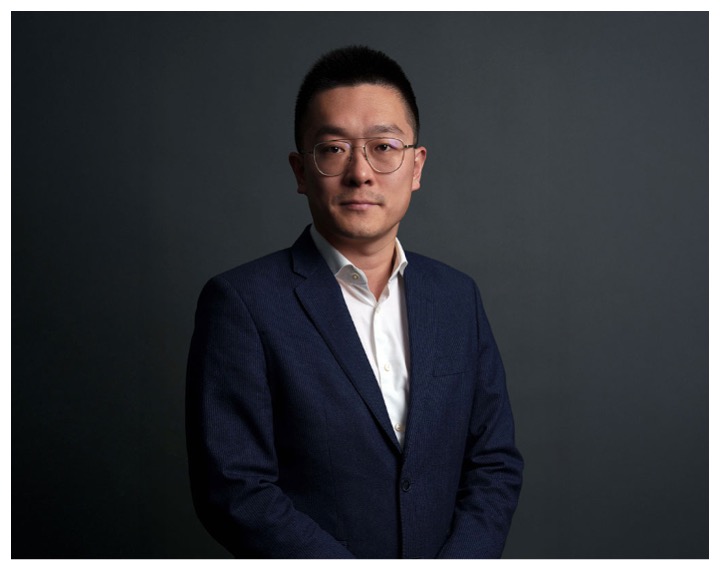
Most property developers come to the industry through finance, land, or family businesses. Rui Liu, Founder and Chairman of LEOS Developments, came to it through architecture — and that difference in starting point still shapes how LEOS operates today, more than a decade later.
A UK Architectural Foundation
Rui trained and qualified as an architect in the United Kingdom, registered with both the Architects Registration Board (ARB) and the Royal Institute of British Architects (RIBA) — the two professional bodies that govern architectural practice in Britain. Alongside his practice, he held academic fellowships within the faculties of several UK universities, a period that sharpened his attention to the details that separate competent buildings from genuinely exceptional ones: proportion, light, material honesty, and how a space actually performs once people live in it.
That grounding in British architectural standards did not stay behind when LEOS expanded into Dubai. It became the company’s defining discipline — the reason LEOS specifies 3.2-metre ceiling heights across its Dubai portfolio, and the reason developments like Knightsbridge are engineered around genuine climate-responsive design rather than decorative sustainability language.
Why an Architect Became a Developer
The shift from architecture to development is a well-worn path for a certain kind of ambitious designer, but the reasoning behind it is rarely articulated as clearly as Rui has put it: as an architect, you hand over your drawings, and then you watch. Budgets get cut in places the eventual buyer will feel for years. Value engineering strips out the details that made a design work. The architect’s vision and the developer’s execution are, in most of the industry, controlled by two different sets of incentives.
Rui founded LEOS in 2012 to close that gap — to put the design decision and the commercial decision inside the same organisation, answerable to the same standards. It is why a specification decision like including a private pool in every unit at Weybridge Gardens 4 was not a marketing feature added after the fact, but a design decision that shaped the development’s commercial plan from the outset.
Building LEOS in the UK First
LEOS Developments began in the UK, growing directly out of Rui’s architectural practice and a network of collaborators who shared his conviction that development could be done with an architect’s discipline rather than a purely commercial one. Those early years were unglamorous by design: land analysis, planning applications, construction management, and the slow accumulation of experience in carrying a project from a sketch to a finished building without losing what made it worth building in the first place.
That UK foundation remains structurally important to LEOS today. The company maintains offices in Weybridge, Surrey — from which its name is drawn — and in London, alongside its Dubai headquarters in Business Bay.
Bringing That Discipline to Dubai
Rui moved LEOS’s centre of gravity to Dubai because the city rewards architectural ambition in a way few other markets do. Ideas like a residence co-branded with an Olympic champion, or a climate-adaptive villa community built around a swimmable lagoon, would struggle to survive a feasibility review in most cities. In Dubai, the operative question is rarely “why would you build that” — it is “how quickly can you deliver it?”
That environment, combined with the design discipline Rui brought from his UK training, is the foundation on which LEOS’s current Dubai portfolio — Hadley Heights 2 in Dubai Sports City, the Weybridge Gardens series in Dubailand, and Knightsbridge in Meydan District 11 — has been built.
An Architect's Standard, Applied at Scale
In October 2024, Rui announced a $7 billion investment initiative targeting more than ten transformative developments across the region. In January 2026, as the company entered its next phase of growth, Jake Jacobs stepped into the role of Chief Executive Officer, with Rui moving into a role focused fully on his position as Chairman — continuing to set the design and strategic direction that has defined LEOS since 2012.
What has not changed, at any stage of that growth, is the underlying discipline: every LEOS project is reviewed against the same standard an architect would apply to a single, personally designed building — not the standard a purely commercial developer might apply to a portfolio.
That is the throughline of Rui Liu’s career: an architect who became a developer specifically so that the buildings he believed in would actually get built the way he designed them.
Rui Liu's Vision for LEOS Developments
When Rui Liu announced a $7 billion investment initiative in October 2024, targeting more than ten transformative developments across the region, it marked a clear statement of intent for LEOS Developments — but the number itself is less revealing than the philosophy behind it.
A Pipeline Built on One Repeatable Formula
Rui’s approach to growth is deliberately formulaic in the best sense: find a location with genuine fundamentals, design something that could not have come from any other developer, specify it to a standard LEOS would accept in the UK, and deliver it exactly as designed. That formula does not distinguish between a single flagship project and a ten-project pipeline — it is meant to scale without dilution.
Today, that vision is visible across three distinct Dubai communities. Hadley Heights 2 in Dubai Sports City brings a genuinely new category to the market — the world’s first residence co-branded with an Olympic champion. The Weybridge Gardens series in Dubailand introduces British-designed, petal-inspired architecture to a district more commonly associated with conventional product. Knightsbridge in Meydan District 11 holds a category-first designation of its own: Dubai’s first climate-adaptive wellness community.
Growth Without Compromise
The discipline underpinning Rui’s vision is as important as its ambition. LEOS projects are self-funded, and every site operates under the same contractor inspection standard — every formwork, every steel bar, every MEP embed checked and rechecked before it is signed off. Rui has been explicit that LEOS will not grow faster than that quality-control discipline allows, describing growth that outpaces quality control as “borrowing against your own name.”
That discipline is why the company’s expansion has been geographically deliberate rather than opportunistic — building first in the UK, then bringing that same standard to Dubai, rather than chasing whichever market offered the fastest short-term returns.
Why Dubai Is Central to the Vision
Rui has spoken about choosing Dubai as LEOS’s second home market specifically because the city does not treat architectural ambition as a risk. A petal-inspired residential tower or a climate-adaptive wellness community with a swimmable lagoon would struggle to clear a feasibility review in most global cities. In Dubai, those ideas are development-ready.
There is a second, more pointed reason behind the choice. Dubai’s off-plan market carries a reputation problem it partly earned — developers who over-promised, renders that outran reality, buyers who received less than they were sold. For a developer whose entire identity is built on closing the gap between design and delivery, that reputation gap is not a threat; it is the clearest possible opportunity to stand apart. Every construction update LEOS publishes, and every project handed over as designed, widens the distance between LEOS and the standard the market has come to expect.
A Leadership Structure Built for the Next Phase
In January 2026, LEOS entered a new stage of its growth as Jake Jacobs stepped into the role of Chief Executive Officer, with Rui moving into a role focused fully on his position as Chairman — continuing to guide the company’s design and strategic direction while Jake leads its operational execution. That structure reflects Rui’s broader vision: a company where design leadership and delivery leadership are distinct disciplines, working in close coordination rather than being combined under a single role.
What the Next Phase Looks Like
The vision Rui has set for LEOS extends beyond any single project milestone. It is a company-wide commitment to a specific promise: that a building sold on renders and specification documents will match, at handover, exactly what was shown at launch. That promise underpins the entire current pipeline — from Hadley Heights 2’s Q4 2027 completion, through the Weybridge Gardens series’ Q2 2027 handovers, to Knightsbridge’s phased delivery through Q4 2027 and Q2 2028.
For a company still expanding its footprint across the UK and UAE, that consistency — more than the headline investment figure — is the real measure of the vision Rui Liu has set for LEOS Developments.
Rui Liu on the Future of Dubai Real Estate
Dubai’s property market has entered a new phase in 2026 — one defined less by rapid across-the-board growth and more by selectivity. For Rui Liu, Founder and Chairman of LEOS Developments, that shift is not a warning sign. It is the market finally rewarding the discipline LEOS was built around.
A Market Becoming More Selective
The data supports Rui’s reading. Dubai recorded its strongest first quarter on record in early 2026, with total real estate transactions reaching AED 252 billion — a 31% year-on-year increase in value. But the second quarter told a more nuanced story: transaction volumes eased 31% year-on-year, driven almost entirely by the secondary market, while off-plan activity — the segment LEOS operates in — eased only 12% and grew to represent 76% of total market activity.
“The market is not losing momentum,” is the reading Rui has offered in industry commentary. “It is becoming more selective about who it trusts with off-plan capital.” That selectivity, in his view, is healthy — it rewards developers with genuine delivery track records over those competing purely on launch pricing.
Off-Plan's Continued Dominance
Off-plan property now accounts for the overwhelming majority of Dubai transactions — a structural shift Rui sees as validating the regulatory framework Dubai has built around escrow protection and milestone-linked construction funding. Buyer confidence in off-plan, he has argued, is no longer blind optimism; it is confidence earned by a regulatory system — RERA-mandated escrow accounts, Oqood registration, milestone-verified fund release — that has matured alongside the market itself.
Where the Growth Is Concentrated
Rui’s view of where Dubai’s growth is genuinely concentrated aligns closely with LEOS’s own portfolio positioning. Dubai Sports City, Dubailand, and Meydan District 11 all feature among the strongest-performing corridors in 2026 transaction data — communities defined by a combination of accessible entry pricing, real infrastructure investment, and increasingly mature lifestyle amenities that no longer require buyers to trade convenience for value.
Meydan District 11 in particular stands out in Rui’s assessment, for a structural reason rather than a cyclical one: low-density planning discipline that constrains new supply, combined with a confirmed Metro Blue Line that will materially improve connectivity to Downtown Dubai by 2029. Analysts project 15–18% near-term capital appreciation in the district as that infrastructure approaches delivery — a dynamic Rui has pointed to as the clearest example of infrastructure-led value creation currently visible in the market.
The Golden Visa Effect
Rui has also highlighted the February 2026 rule change to the UAE Golden Visa property route — which removed the requirement to have paid 50% of a property’s value before applying — as one of the most consequential policy shifts for real estate investors in recent years. By opening the 10-year residency route to the majority of off-plan and mortgaged buyers for the first time, the change has widened Dubai’s investor base meaningfully, with investor residency applications rising 34.7% year-on-year in the first quarter following the change.
Discipline as the Differentiator
Asked what the next phase of Dubai’s market will reward, Rui’s answer returns consistently to the same theme: developer discipline. As new project launches slowed sharply through 2026 — down more than 55% year-on-year by unit count in the first quarter — buyers gained more time to conduct due diligence rather than racing to secure allocation in a hot launch. That shift favours developers with consistent inspection standards, self-funded balance sheets, and a track record of delivering what was promised.
For LEOS, operating across Dubai Sports City, Dubailand and Meydan with a fully RERA-registered, escrow-protected portfolio, that is precisely the environment Rui has spent over a decade building the company to compete in.
Rui Liu's Most Significant LEOS Projects
Three developments currently define the LEOS Developments portfolio under Rui Liu’s design leadership, each representing a different expression of the same underlying discipline: a genuine category-first idea, executed to a standard LEOS’s UK architectural roots demand.
Hadley Heights 2 — Dubai Sports City
Hadley Heights 2 holds a distinction no other residential development in the world can claim: it is the first residence formally co-branded with an Olympic champion. The partnership with triple Olympic gold medallist Tom Dean was not, in Rui’s own account, built around a launch-event appearance — it shaped the building’s entire specification.
The development’s wellness and performance amenities — AI-powered fitness arenas, a sky vitality deck, a VitaPlay gaming and VR lounge, and a private pool in every single unit, down to the studios — exist because the partnership demanded a standard that matched an Olympic athlete’s own relationship with performance. Rui has described the resulting building as “a launchpad for champions,” a description that only holds because an actual champion held the project to it throughout design.
Hadley Heights 2 is scheduled for completion in Q4 2027, with studios starting from AED 727,328.
Weybridge Gardens 3, 4 & 5 — Dubailand
The Weybridge Gardens series represents the clearest expression of Rui’s architectural background applied directly to Dubai’s market. Named for the Surrey town where LEOS’s UK practice is based, the series brings a distinctly British-designed, petal-inspired architectural language to Dubailand — organic balcony forms and curved facades that stand apart from the district’s more conventional residential stock.
Across its three editions — The Alps (Weybridge Gardens 3), Kensington Edition (Weybridge Gardens 4), and Legacy Edition (Weybridge Gardens 5, designed in collaboration with LUD Studios) — the series shares a consistent commitment to specification quality that Rui has insisted on regardless of price point: every unit at Weybridge Gardens 4 and 5, from studio to four-bedroom Sky Villa, includes its own private pool.
The series is scheduled for completion between Q3 2026 (Weybridge Gardens 3) and Q2 2027 (Weybridge Gardens 4 and 5), with studios starting from AED 550,000.
Knightsbridge — Meydan District 11
Knightsbridge carries its own category-first distinction: Dubai’s first climate-adaptive wellness community. Built around a swimmable lagoon in Meydan District 11, the development applies genuine environmental engineering — self-shading building facades, UV-proof double glazing, solar water heating, smart irrigation systems, and enhanced drainage — rather than the decorative sustainability language common across the market.
Rui has been explicit that Knightsbridge’s environmental features are functional engineering decisions, not marketing additions: the self-shading facade orientation and glazing specification were determined by genuine climate performance modelling, not aesthetic preference alone. Every villa and townhouse across both phases includes a private pool, a private elevator, and a bespoke fresh harvest garden.
Phase 1 (112 townhouses and villas) is scheduled for completion in Q4 2027, with Phase 2 (46 villas) following in Q2 2028. Prices start from AED 7.94 million.
A Consistent Standard Across Three Different Ideas
What connects these three projects is not a shared architectural style — Hadley Heights 2’s aerodynamic tower form, Weybridge Gardens’ organic petal balconies, and Knightsbridge’s low-rise waterfront villas share almost no visual language. What connects them is Rui’s insistence that each represents a genuine category-first idea, backed by a specification standard consistent across every price point in the portfolio, from Weybridge Gardens 3’s AED 550,000 studios to Knightsbridge’s AED 21.6 million signature villas.
That consistency — rather than any single flagship building — is what Rui Liu has described as the real measure of LEOS’s design leadership under his direction.
Rui Liu Awards and Industry Recognition
Recognition in property development takes more than one form. For Rui Liu, Founder and Chairman of LEOS Developments, that recognition spans professional architectural credentials, formal industry awards, and — perhaps most tellingly — the world-class names who have chosen to attach their own reputations to LEOS’s projects.
Formal Industry Recognition
Rui’s leadership at LEOS has been recognised across three major industry platforms:
- Construction Week Influential Leaders 2026 — recognising Rui among the region’s most influential figures shaping the construction and property sectors.
- REM Times Top 100 Developer 2025 — placing Rui among the top developers recognised by REM Times for the scale and quality of LEOS’s UK and UAE portfolio.
- Forbes Most Impactful Real Estate Leader 2025 — a recognition of Rui’s broader influence on the real estate industry, reflecting both LEOS’s design credentials and its growing delivery track record.
Professional Recognition as an Architect
Beyond these formal industry awards, Rui’s foundation as a UK-qualified architect, registered with both the Architects Registration Board (ARB) and the Royal Institute of British Architects (RIBA), represents a level of professional credentialing that few property developers hold personally. Alongside his practice, he served as an academic fellow within the faculties of several UK universities — a form of peer recognition within the architectural profession itself, distinct from commercial industry awards.
Recognition Through Partnership
One of the clearest signals of industry standing in real estate is which partners choose to attach their names to a project — and Rui has been direct about what that signals. World-class figures do not lend their reputations cheaply; athletes and public figures at the top of their fields have far more to lose from a bad association than a developer does from a missed launch event.
The partnership behind Hadley Heights 2 with triple Olympic gold medallist Tom Dean is the clearest example. It is the first residence in the world formally co-branded with an Olympic champion — a distinction that required LEOS’s specification to meet a standard Tom Dean himself was prepared to have his name held against. Rio Ferdinand’s involvement with LEOS carries similar weight: partners operating at that level in professional sport bring an intolerance for detail and delivery slippage that, in Rui’s account, makes every project better before a single buyer ever sees it.
Recognition Through Delivery
Beyond formal awards and partnerships, Rui has argued that a developer’s most meaningful recognition comes from the market itself — repeat buyers, sustained demand across multiple projects, and a construction record that matches what was promised at launch. LEOS’s current Dubai portfolio — Hadley Heights 2 in Dubai Sports City, the Weybridge Gardens series in Dubailand, and Knightsbridge in Meydan District 11 — operates under consistent RERA registration, DLD escrow protection, and a self-funded balance sheet specifically to build that form of recognition over time.
What Recognition Means to Rui
Asked what form of recognition matters most, Rui has consistently returned to a single measure: whether a building, at handover, matches exactly what was shown at launch. Awards, he has said, are only ever a claim; delivery is the proof. That framing shapes how LEOS approaches every external validation the company receives — architectural credentials, industry awards, and high-profile partnerships alike are treated as evidence to be earned continuously, not achievements to rest on.
Rui Liu on Architecture, Sustainability and Community Design
Sustainability has become one of the most overused words in property marketing — attached to developments that offer little beyond a solar panel on the roof and a line in the brochure. Rui Liu, Founder and Chairman of LEOS Developments, has been openly critical of that gap between language and engineering, and Knightsbridge, LEOS’s climate-adaptive wellness community in Meydan District 11, is his clearest answer to it.
Sustainability as Engineering, Not Marketing
Rui’s approach to sustainable design starts from a position his architectural training makes non-negotiable: a sustainability feature that does not function is not a sustainability feature, regardless of what it says on a factsheet. At Knightsbridge, that principle shows up as self-shading building facades and orientation decisions determined by genuine climate performance modelling, not aesthetic preference. It shows up in UV-proof double glazing specified for measurable thermal performance, not for marketing copy.
The result is Dubai’s first development to carry the designation of a climate-adaptive wellness community — a distinction earned through a specific combination of engineering choices: solar water heating, energy-efficient LED lighting throughout, smart irrigation systems calibrated to the community’s actual water needs, and a lake filtration system maintaining the swimmable lagoon at the development’s centre.
Designing for Community, Not Just Climate
For Rui, sustainable design and community design are not separate disciplines — they are the same problem approached from different angles. A climate-adaptive facade that reduces cooling load only matters if the space it creates is one people actually want to inhabit. That thinking shows up at Knightsbridge in details that sit alongside the environmental engineering: a Karesansui balcony garden on every unit, climate-controlled outdoor shaded terraces, and a community layout built around a three-minute walk to a swimmable lagoon rather than around vehicle access alone.
Every villa and townhouse at Knightsbridge includes a bespoke fresh harvest garden — a detail Rui has pointed to as characteristic of the broader philosophy: sustainability that residents interact with daily, rather than sustainability that exists only in a specification document.
Applying UK Standards to a Different Climate
Rui’s architectural training in the UK shapes how he approaches sustainable design in a fundamentally different climate. British building standards are built around insulation and heat retention; Dubai’s climate demands the opposite discipline — heat rejection, shading, and water efficiency in a desert environment. Rui has described Knightsbridge’s engineering as taking the same rigour British regulations demand and re-solving it for Dubai’s conditions, rather than importing UK solutions wholesale.
That re-solving is visible in specifics: an insulated building envelope and enhanced drainage system engineered for Dubai’s occasional intense rainfall events, EV charging facilities anticipating the UAE’s shift toward electric vehicles, and a 10-year waterproofing warranty reflecting a construction standard closer to UK regulatory expectations than to typical regional practice.
Why This Matters Beyond One Project
Rui has framed Knightsbridge’s sustainability engineering as a template rather than a one-off feature set — evidence that genuine climate-responsive design and commercial viability are not in tension, provided the engineering decisions are made early enough in the design process to shape the commercial plan rather than being added to it afterward. That sequencing — design first, commercial plan built around it — is the same principle underpinning every LEOS development, applied here specifically to the question of sustainability and community.
For Rui, the measure of whether a sustainability claim is genuine is simple: could it survive being explained in full engineering detail to a skeptical buyer, rather than summarised in a single marketing line? Knightsbridge, in his account, was designed to pass that test