

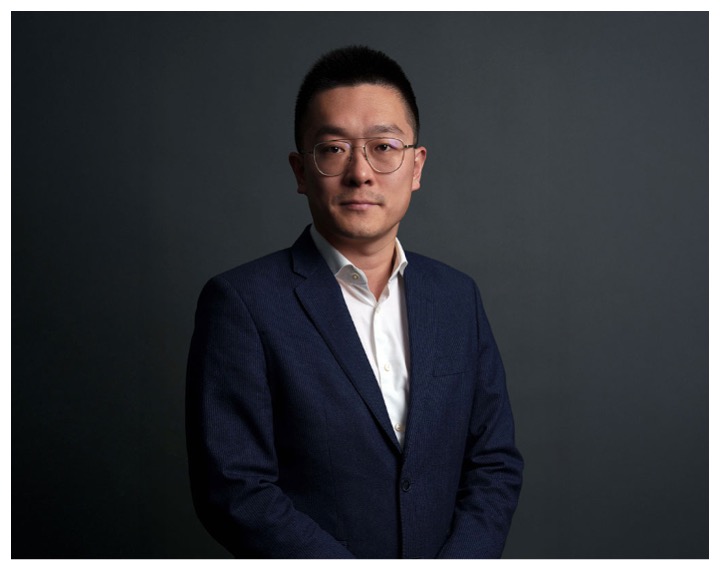
Most property developers come to the industry through finance, land, or family businesses. Rui Liu, Founder and Chairman of LEOS Developments, came to it through architecture — and that difference in starting point still shapes how LEOS operates today, more than a decade later.
A UK Architectural Foundation
Rui trained and qualified as an architect in the United Kingdom, registered with both the Architects Registration Board (ARB) and the Royal Institute of British Architects (RIBA) — the two professional bodies that govern architectural practice in Britain. Alongside his practice, he held academic fellowships within the faculties of several UK universities, a period that sharpened his attention to the details that separate competent buildings from genuinely exceptional ones: proportion, light, material honesty, and how a space actually performs once people live in it.
That grounding in British architectural standards did not stay behind when LEOS expanded into Dubai. It became the company’s defining discipline — the reason LEOS specifies 3.2-metre ceiling heights across its Dubai portfolio, and the reason developments like Knightsbridge
are engineered around genuine climate-responsive design rather than decorative sustainability language.
Why an Architect Became a Developer
The shift from architecture to development is a well-worn path for a certain kind of ambitious designer, but the reasoning behind it is rarely articulated as clearly as Rui has put it: as an architect, you hand over your drawings, and then you watch. Budgets get cut in places the eventual buyer will feel for years. Value engineering strips out the details that made a design work. The architect’s vision and the developer’s execution are, in most of the industry, controlled by two different sets of incentives.
Rui founded LEOS in 2012 to close that gap — to put the design decision and the commercial decision inside the same organisation, answerable to the same standards. It is why a specification decision like including a private pool in every unit at Weybridge Gardens 4 was not a marketing feature added after the fact, but a design decision that shaped the development’s commercial plan from the outset.
Building LEOS in the UK First
LEOS Developments began in the UK, growing directly out of Rui’s architectural practice and a network of collaborators who shared his conviction that development could be done with an architect’s discipline rather than a purely commercial one. Those early years were unglamorous by design: land analysis, planning applications, construction management, and the slow accumulation of experience in carrying a project from a sketch to a finished building without losing what made it worth building in the first place.
That UK foundation remains structurally important to LEOS today. The company maintains offices in Weybridge, Surrey — from which its name is drawn — and in London, alongside its Dubai headquarters in Business Bay.
Bringing That Discipline to Dubai
Rui moved LEOS’s centre of gravity to Dubai because the city rewards architectural ambition in a way few other markets do. Ideas like a residence co-branded with an Olympic champion, or a climate-adaptive villa community built around a swimmable lagoon, would struggle to survive a feasibility review in most cities. In Dubai, the operative question is rarely “why would you build that” — it is “how quickly can you deliver it?”
That environment, combined with the design discipline Rui brought from his UK training, is the foundation on which LEOS’s current Dubai portfolio — Hadley Heights 2
in Dubai Sports City, the Weybridge Gardens series in Dubailand, and Knightsbridge in Meydan District 11 — has been built.
An Architect's Standard, Applied at Scale
In October 2024, Rui announced a $7 billion investment initiative targeting more than ten transformative developments across the region. In January 2026, as the company entered its next phase of growth, Jake Jacobs stepped into the role of Chief Executive Officer, with Rui moving into a role focused fully on his position as Chairman — continuing to set the design and strategic direction that has defined LEOS since 2012.
What has not changed, at any stage of that growth, is the underlying discipline: every LEOS project is reviewed against the same standard an architect would apply to a single, personally designed building — not the standard a purely commercial developer might apply to a portfolio.
That is the throughline of Rui Liu’s career: an architect who became a developer specifically so that the buildings he believed in would actually get built the way he designed them.
